
Why You Feel So Isolated as a Highly Sensitive Entrepreneur
I used to lead workshops for leadership teams and look entirely at ease. The work went well. People valued it. What they could not see was how much I was…
Your life can look good from the outside and still feel strangely far away from you. You may be healthy, productive, successful, surrounded by beauty, and yet something in you knows: something isn’t right.
If you’re asking, “Why do I feel lost even when life is good?”, the answer may not be your job, your partner, your car, or the people around you. You may have lost contact with your sense of purpose and moved away from yourself. After 15 years of working as a therapist and coach, and through my own periods of lostness, I’ve come to see this feeling as a signal, not a malfunction.
You may already be doing the things that are supposed to help, yet still ask, “why do I feel lost even when life is good?”
You exercise. You do yoga. You eat well. You read the right books.
A healthy daily routine can improve how you function without resolving deeper disconnection. Personal growth can help, but it can’t replace honest self-connection.
These things can make you sharper, healthier, and more productive. And oftentimes we are expecting that moment where you lean back and feel everything is okay.
Peace of mind. Silent calm. Serenity.
For many people, that moment doesn’t arrive. And when it doesn’t, it may be time to look beneath the habits, routines and polished surface of your life.
Feeling lost doesn’t always mean you or your life is broken. It can mean that something deeper in you is asking to be seen.
Taking care of yourself isn’t only about doing the right things. You can maintain a healthy body, a full calendar, and a successful life while remaining disconnected from the part of you that needs your attention most.
But in times of inner struggle there is a deeper calling. Something inside of you wants to be recognized. It wants the real you, not only the version of you that is effective, organized, and doing fine.
Most of us have learned how to move forward. We make to-do lists. We plan our days and weeks. We build systems. We organize our responsibilities. We become more effective.
Then, step by step, something else can happen. You can gradually lose contact with yourself and begin living on autopilot.
You are moving, achieving, handling things, and getting through the next item. But you aren’t moving deeper. You may be feeling stuck, unable to change direction inwardly or get closer to yourself.
You can move forward in life without moving closer to yourself.
There is often an expectation that if you do enough right things, there will eventually be an arrival point. Societal pressures can make achievement seem like the path to fulfillment. You will feel settled. You will feel complete. You will finally be able to rest inside your own life.
But when your inner experience doesn’t meet that expectation, the distance becomes hard to ignore. You are still taking the next logical steps, but you don’t feel that you are arriving anywhere that matters.
This isn’t a failure of discipline or gratitude. It’s difficult to see where you are heading while you are still in fast motion.
At first, the signal is subtle. When you’re feeling lost in life, you may feel more stressed than usual.
You may notice that you’ve been moving forward for weeks without checking in with yourself. Emotional awareness can help you notice stress, sadness, and disconnection before they become overwhelming.
Over time, the signal gets louder. The emotional strain grows. You begin to recognize that the way you are moving through life may not be working anymore.
You may notice:
Burnout and stress can contribute to these experiences, but they aren’t always the whole explanation. Sometimes, they point to a deeper loss of contact with yourself.
You may feel unfulfilled and empty, even when objectively positive things are happening around you.
This can be one of the most frustrating parts. You may be in a beautiful place, looking at something you once would have loved, and nothing lands.
It’s as if there is a gap between what is happening around you and what your heart can receive.
I know this experience well. I had it when I came to Mallorca, a place of extraordinary beauty. When I arrived here, I cried because it was so beautiful. Yet during a phase of lostness, I sat outside in that same nature and couldn’t feel any of it.
I knew I had built and created to come to this beautiful place. But I couldn’t enjoy it. That disconnection created so much tension inside of me that I had to face what was happening and look deeper.
If these feelings persist, worsen, or begin to interfere with daily life, professional support may help you understand what you need.
Lostness isn’t your fault. It is something that happens again and again. It is delicate work to recognize where you are heading while you are on autopilot. So the experience of lostness is a signal.
The feeling is an invitation.
It may be time to stop pretending that everything is fine. It may be time to ask what is underneath your exhaustion, your distraction, your subtle sadness, and your lack of feeling. You may be searching for a clearer sense of purpose, or reconnecting with a deeper experience of meaning and purpose.
Feeling lost can be an invitation to go further into yourself.
This isn’t about forcing a solution or making emotional discomfort disappear. It is about offering yourself more honesty, attention, and space, so your inner compass can become easier to notice.
You may already be an introspective person. You might notice your thoughts, emotions, habits, and patterns. You aren’t blindfolded to your inner world.
Still, there are phases when your current level of self-awareness isn’t enough to reveal what is asking to be seen.
These periods are sometimes called the “dark night of the soul” or the “dryness of the spirit.” They can bring low energy, difficult moods, negative emotions, and a sense of inner darkness. They may also raise existential questions that analysis alone can’t resolve.
When I look at the biographies and journals of Carl Jung, saints, mystics, and other explorers of consciousness, I see a shared pattern. They entered difficult inner places. They faced moods, emotions, and states they couldn’t simply think their way out of.
But when they came through, something became visible that they hadn’t been able to see before. The dark night of the soul and the search for meaning has long been described as an experience that can touch the foundations of a person’s inner life.
The struggle isn’t proof that you lack self-awareness. Sometimes you’re simply too stubborn to see the deeper and wider aspects of yourself until the tension makes you stop.
Something inside of you wants to become more visible. I call it a deeper intelligence, a deeper being, a secret something that keeps knocking at the door.
It wants you to open.
Wholeness isn’t a final stage where you become perfect or completely aware of every part of yourself. It is a form of personal growth grounded in seeing, sensing, expressing, and living more of who you are.
Wholeness is a deeper relationship with more of yourself.
We may never become fully aware of everything inside us. But even becoming aware of 1%, 2%, 5%, or 10% more of who you are can change how you experience life. That small shift is where personal growth becomes tangible.
I have had moments, often after days or months of intense struggle, where something suddenly opened. I could see something about myself that had been invisible before.
Those moments are revealing and healing because you are moved by a recognition that isn’t theoretical. You see more of who you are, and you reconnect with it.
The journey doesn’t end there. Another layer may appear later. But each opening brings you closer to the real self.
I will be direct here. Much of what you find in self-improvement culture rests on an egocentric fantasy: do this, get that. Follow this procedure, become whoever you want to be. Buy the book, read it, and feel happy.
It sounds appealing because we want it to be easy.
But an affirmation such as “I’m doing fine” won’t resolve a deeper loss of self-connection. A temporary high after reading something inspiring can help, but it isn’t the same as becoming more whole.
I’m not saying tools, books, methods, therapy, or scientific journals have no place. They can offer useful support and serve as coping mechanisms while you move through difficult experiences. Powerful methodologies can also create experiences where you see more of yourself.
The problem is the promise that a technique can make you whole on command. You cannot force yourself into more consciousness. You cannot pressure yourself into wholeness because it would fit better in your calendar.
You are being processed and transformed by the experience itself.
Have your tools beside you. Read the books. Use methods that support you. But let the experience work with you, even when it is unpleasant.
There is an authentic path for you because you are an individual. There is a particular symphony inside you, with its own notes, tension, beauty, and complexity.
You cannot play someone else’s notes and expect to find yourself. Their goals may not reflect your core values, personal values, or lived experience.
Other people’s work can inspire you. A book can open something. A practice can give you a useful experience. But copying another person’s process can’t determine your life direction or replace your own inner work.
You can use tools, but you still have to walk your own path.
Don’t try to fast-forward lostness because it doesn’t fit your schedule. This isn’t another task to finish.
The deeper self often speaks in quiet ways. Constant action, distractions, to-dos, and noise make it hard to hear.
Give yourself enough space to notice what comes up. A dream. A brief insight. A new feeling you haven’t felt before. Notice it and explore what it opens up for you.
You don’t have to fix the feeling immediately. Start by sensing what is happening.
Ask yourself:
The point is not to solve your entire life in one sitting. The point is to stop looking away.
Take a pen and a sheet of paper. Give yourself 20 to 30 minutes without distraction. Treat this as a focused self-reflection exercise, not a task to solve everything at once.
Write down everything that feels out of alignment with who you truly are. Don’t censor yourself. Don’t redact. Don’t soften what you know. Don’t slide away from the things you don’t want to see.
Your mind will have opinions, of course. But pay attention to your heart. What does it tell you isn’t right for you at this moment?
There may be things on the page that you can’t change right now. That’s okay. This practice is not about changing everything. It is about noticing what is there.

When you are finished, look at the page and circle three or four areas that carry the strongest charge. They may be projects, responsibilities, relationships, patterns, or parts of your life that feel especially heavy.
Then look at them without trying to solve them.
Honesty itself can begin to create movement. When you see what is out of alignment, new ideas and energy can appear. An insight may come from a place you can’t access through thinking alone.
You might notice a moment when you would normally react, then pause for a second and respond differently. Your mind may say, “I can’t do this,” or, “I can’t fix that.” Watch the thought, but don’t follow it automatically.
Once you stop pretending that everything is fine, you allow the deeper self to communicate with you. Take your time with it.
The real self isn’t a fantasy about the best version you could become. It is the raw, strange, complex, beautiful version of you that wants to be experienced. Through these signals, it can act as an inner compass, gently pointing you forward whenever you feel lost.
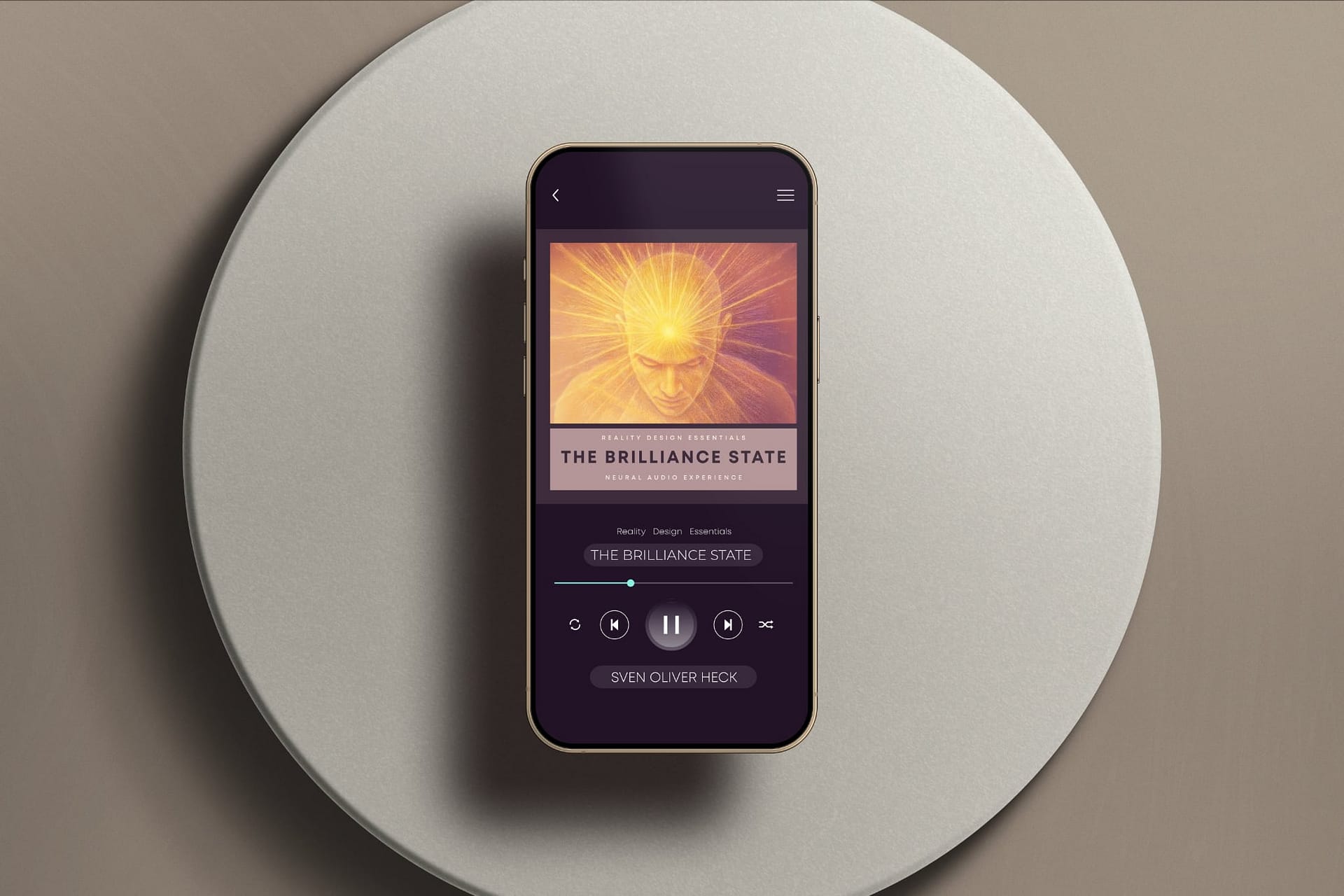
For moments when your mind is loud and scattered, The Brilliance State is a guided meditation created to help you return to a clearer, more centered state.
Across my own life and years of working with clients, I have seen the same thing again and again. Suffering is often connected to a lack of self-connection.
Happiness, fulfillment, and peace of mind are connected to being more deeply connected with yourself.
This doesn’t mean that all pain disappears. It means you begin relating to your inner life with openness, honesty, care, and self compassion. You stay present with pain instead of trying to overpower, improve, or silence it.
The secret something isn’t another technique. It is your relationship with yourself.
Not necessarily. Lostness may involve those parts of life, but it doesn’t prove that one external thing is the problem. Notice what feels out of alignment before making major changes.
Yoga, exercise, healthy food, and helpful books can support you. But they may not reach the deeper part of you that wants to be recognized. Lostness can call for a more honest relationship with yourself, not another habit to add.
Tools and methods can support the process. They can create space to see more of yourself. But they can’t guarantee wholeness or replace the personal experience you need to move through.
Feeling lost in life can arise during ordinary uncertainty, major change, burnout, or disconnection. When low mood, loss of interest, hopelessness, sleep or appetite changes, or difficulty functioning persist, mental health support may be appropriate. Consider seeking professional support from a qualified mental-health professional for a proper assessment. If you may harm yourself, contact urgent local help or emergency services now.
Begin with what feels painful, overwhelming, distracting, or out of alignment. You don’t need a perfect answer. Give yourself time and let what’s already present come onto the page.
Feeling lost when life is good doesn’t mean you’ve failed. You can feel directionless and unfulfilled without having objectively failed.
Don’t rush to make the signal disappear. Let it show you where you’ve lost contact with the parts of you that want to be seen.
If this feeling persists or feels difficult to navigate alone, professional support may help you identify what needs your attention now. You can Work with me to find your next steps back into self-connection.